PHOTO PRINCIPLES / PRINCIPLE 30
Find the rhythm.
Show the exception.
A row of chairs can look ordinary until one chair has a different colour. Then you notice both the arrangement and its interruption. This exercise is about photographing that relationship. You do not need the most unusual object; you need a view that explains why one object stands out among its neighbours. A few deliberate changes of position can turn an everyday arrangement into a clear composition.
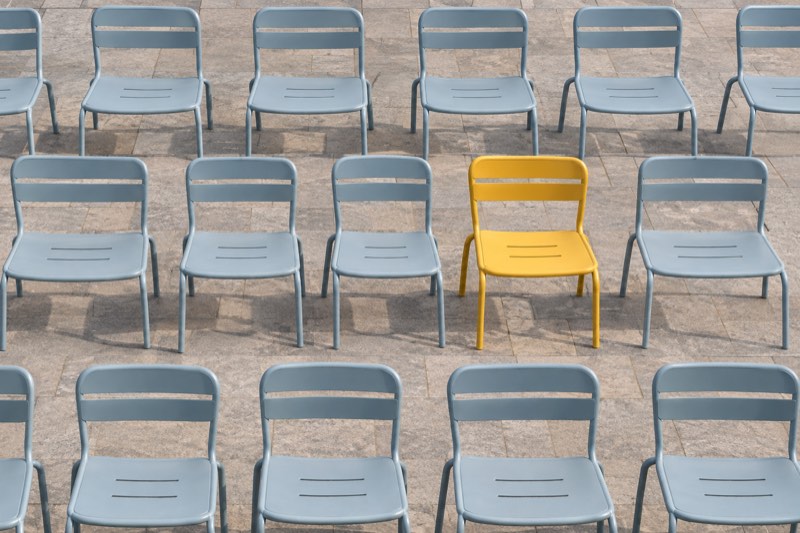
Photograph repeating shapes with your phone. Choose one exception, separate the rows and include enough neighbours to make the pattern readable.
Identify what repeats
Name the recurring unit: chair backs, windows, round plates or the gaps between boards. Decide which rhythm matters most. When several arrangements compete within one scene, choose a section with one clear order. The objects do not need to be perfectly identical for the repetition to make sense.
Nikon describes a break in a pattern as a possible focal point. In our example, similar chairs form a quiet group and one different colour provides an accent. Treat this as an exercise to explore, rather than a rule every photograph must follow.
Keep the exception with its neighbours
A very tight photograph of the yellow chair shows only a chair. A very wide photograph may lose it in the whole square. Find a frame that includes the distinctive object and enough neighbouring examples to explain its role. There is no universal object count: judge the relationship in a small preview.
Make a wider and a tighter version from the same position. Can you still describe the repeated arrangement in both? If the tighter version loses it, return to the wider view or change position. Keep the important outline of your chosen exception intact.
Separate the rows with your viewpoint
From a low position, chair backs may overlap. Raising the phone slightly, without climbing on furniture, may reveal useful gaps between rows. Pay attention to empty spaces as well as objects: both contribute to the visible arrangement.
Compare a straight-on view with a slightly angled one. The first can emphasise regularity; the second can show rows receding into depth. Converging lines are not automatically a mistake. Choose them deliberately instead of tilting the phone simply to manufacture a more dramatic picture.
Check light and focus on the accent
A different colour may not help if glare or deep shade hides the important object. Inspect the preview and wait for calmer light when possible. On reflective surfaces, a small change of angle can sometimes reduce an unwanted bright reflection.
If your camera allows a selected focus point, choose the distinctive object and inspect detail after taking the picture. Strong background blur is not always useful here: the neighbours explain the pattern. Available controls and image processing vary between cameras and apps.
Remove competing accidental accents
A bright bag at the edge, a sign or part of a passer-by can attract more attention than your chosen chair. Check all four edges and corners. A small movement of the phone often helps before you need to consider editing anything out.
Cropping some repeating elements at the boundary can suggest that the arrangement continues. Make those cuts deliberate and avoid turning your main accent into an accidental half-object. Do not move other people’s belongings or block a walkway while searching for the right view.
Sometimes keep only the rhythm
An unbroken arrangement can communicate calm, scale or order. Do not add a contrasting object just because this exercise includes one. Several irregularities may also say more about a real place than a perfect grid; show that character when it serves your subject.
Avoid pushing saturation excessively just to make the exception visible. Adjust framing and spatial relationships first. If a caption has to explain which object matters, consider whether the photograph itself gives that object enough clarity.
Exercise: three versions of one arrangement
From a safe place, make three photographs: a regular section without an exception, the exception with its neighbours, and a broad view of the setting. Keep the same lens. Compare the pictures at an equal display size and name what catches your attention first in each.
Choose the version that best communicates your intended subject and note one change for another attempt. Practise deliberate framing with Take PRO. The chair illustration was generated with AI and is not a photograph taken with the app.