PHOTO PRINCIPLES / PRINCIPLE 24
Find a diagonal.
Keep the phone level.
A diagonal crosses the frame at an angle. It can make a stationary scene feel more active, even when nothing moves. You do not have to rotate the phone to create it: a staircase, a sloping branch or the edge of a table seen from one side already offers an angle. The useful question is whether that angle strengthens the photograph you want to make.
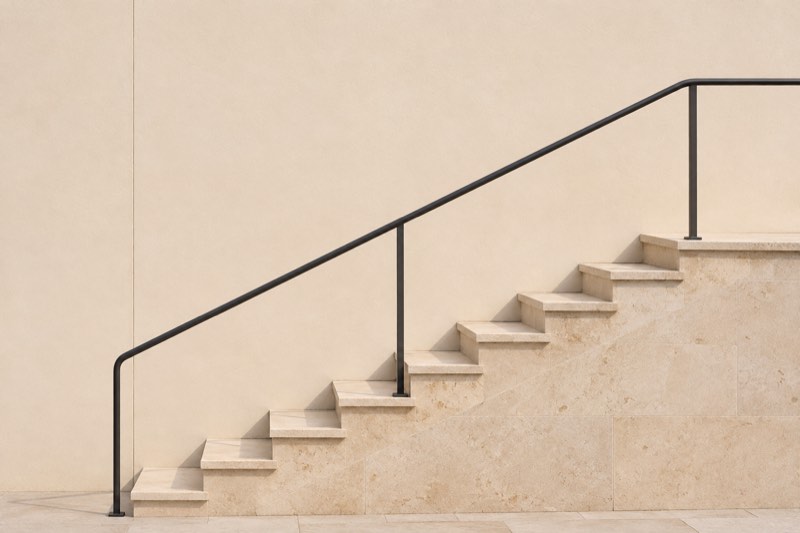
Use a staircase, railing or table edge to build a dynamic composition. Keep your phone level, choose the viewpoint and practise with three deliberate frames.
Separate the line from the camera angle
In the illustration, the handrail rises while the posts remain upright. That contrast lets you recognise a diagonal inside a stable frame. Nikon School notes that diagonal lines can add dynamism and depth. Here, the exercise concentrates on finding such a line while avoiding accidental camera roll.
A diagonal need not connect two opposite corners or sit at exactly 45 degrees. A gentle slope can work too. Decide whether the line itself is your subject or whether it should support another subject; those are different jobs.
Find a safe, simple viewpoint
Look for stairs you can photograph from a public, level standing area. Remain clear of the route people need to use. Start from the side, where the sloping rail is easy to distinguish from the upright supports. A plain wall makes the geometry easier to read.
Hold the phone without rotating it clockwise or anticlockwise. Use a genuinely vertical reference near the middle, such as a post, to notice accidental roll. Perspective can still make distant verticals converge when you aim upward; that is different from rotating the whole frame.
Choose where the line enters and leaves
Frame the start of the rail and leave enough space near its upper end to understand the landing. You do not need to show every step. Check what happens where the diagonal meets the edge: an awkward fragment or a bright sign can interrupt the intended shape.
Make one photograph, then move a little sideways on the same safe surface. Keep the phone level and compare the new line placement. Moving changes the relationships in the scene; merely rotating the phone tilts every element together.
Try the principle away from stairs
At a table, photograph a rectangular notebook from an oblique viewpoint so one edge runs diagonally through the frame. Keep its identity clear and avoid placing unrelated objects just to fill the corners. The notebook provides a quiet indoor practice option.
A sloping tree branch or a roof edge can also supply a diagonal. Check the background for competing lines. One clean direction is often easier to understand than several equally strong directions, especially when the photo is viewed as a small thumbnail.
Common errors and useful exceptions
Do not tilt a horizon accidentally just to make a railing look more dramatic. Avoid forcing a line into a corner if that cuts off an important shape. A diagonal is a compositional choice, not a guarantee that the image has a clear subject or a useful story.
An intentional tilted frame can suit an energetic or unsettling picture. Try it as a separate, deliberate version rather than treating it as the only way to add movement. Calm horizontal compositions and strict symmetry remain equally valid when they match the scene.
Five-minute exercise
Photograph the same staircase from three safe positions: directly from the side, a little farther left and a little farther right. Keep the phone upright, use the same orientation and do not change the lens during this comparison. Inspect where the rail enters, where it ends and what competes with it.
Choose the version with the clearest shape and explain why in one sentence. Repeat indoors with the notebook if stairs are unavailable. Use Take PRO for your next everyday composition practice. This AI-created illustration explains the principle; it does not show a result produced by the app.